
How Courts Decide in Fair Value vs Market Value Shareholder Disputes
This NSW Supreme Court case highlights how courts approach share valuation when no clause is specified in the shareholders’ agreement. The judgment offers critical guidance on how to resolve a fair value vs market value shareholder dispute, especially where control premiums or minority discounts may apply.
It involved a bitter shareholder valuation dispute between family members in a private company. With no clear valuation clause in the shareholders’ agreement, the court had to decide how to value the departing member’s shares. Should it be market value, which could include discounts for minority holdings, or fair value, which might reflect the true worth of the interest without such discounts? The outcome would set a clear precedent for any future fair value vs market value shareholder dispute.
The judgment provides important guidance on how courts interpret valuation clauses or the lack of them and highlights the risks of vague drafting in shareholder agreements.

Legal Insight: Valuation Without a Clear Agreement
The dispute arose between siblings who each held shares in Coshott Holdings Pty Ltd, a closely held family company. After relations deteriorated, one party sought to exit and be bought out. The key question was what was the appropriate basis for valuing their interest?
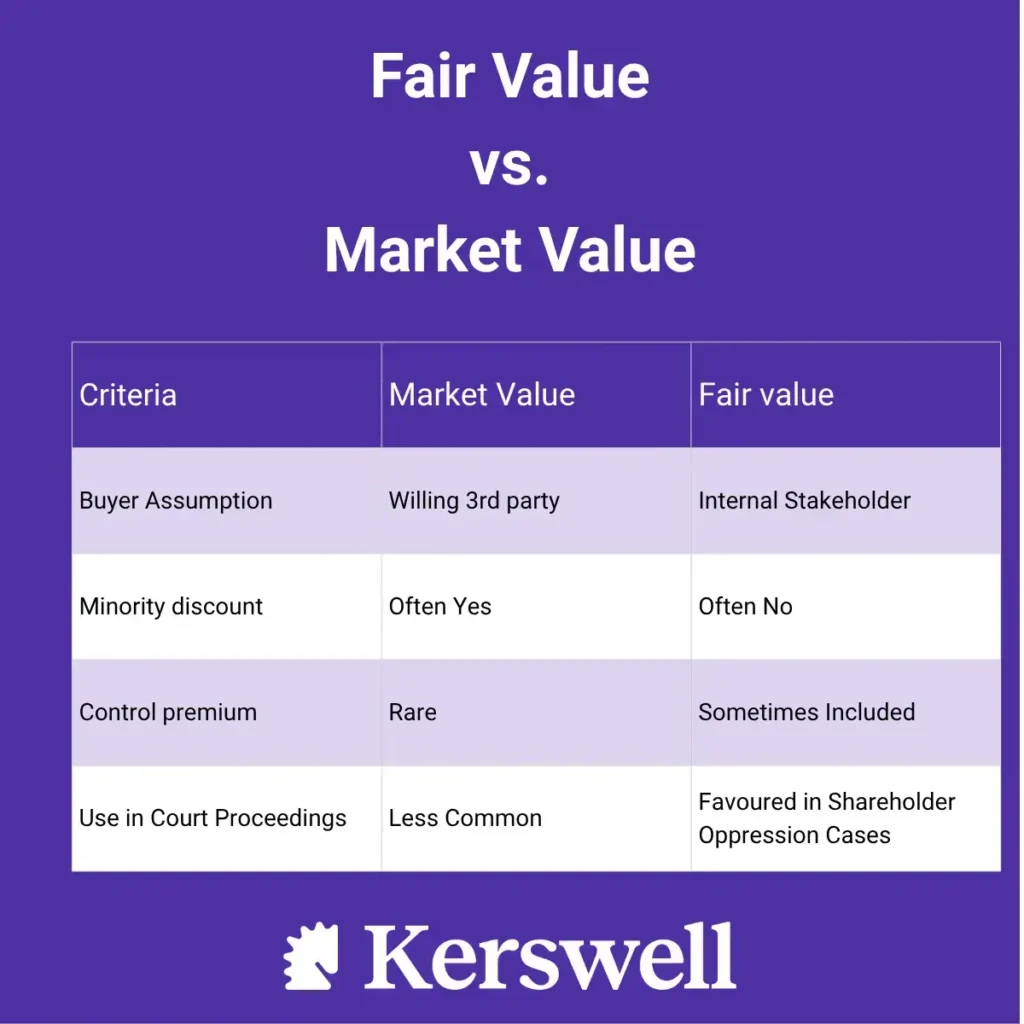
The court concluded that in the absence of a clearly defined valuation mechanism in the shareholders’ agreement, the default position is fair value rather than market value. Fair value was interpreted to mean a valuation that does not apply discounts for minority interest and may include control premiums where justified.
This reinforces a growing body of case law that prioritises fair value when resolving a shareholder valuation dispute, especially where there is no express valuation clause.
This distinction is particularly relevant in family-run or small private companies where shares may not be readily tradable and where typical market valuation principles such as a discount for illiquidity or lack of control may not reflect the true commercial reality.
The decision drew heavily on established principles from cases like In the matter of Scientific Management Associates Pty Ltd [2019] and clarified that in the context of oppression proceedings or buyouts under sections 232 to 234 of the Corporations Act, fair value is often used to avoid unjust enrichment of the majority.
The decision reinforces how critical expert input is when advising clients in a shareholder valuation dispute, particularly one that turns on whether the outcome should reflect fair value or market value. Courts are increasingly focused on fairness and substance over hypothetical transactions, which is central to resolving a fair value vs market value shareholder dispute.
Relevance to Practitioners
This ruling is highly relevant for commercial litigators dealing with shareholder disputes, especially in the context of family businesses or other closely held entities. It underscores several practical points:
- Drafting matters: Shareholder agreements should clearly define valuation methodologies in exit clauses or forced buyout scenarios. Ambiguity opens the door for litigation and unpredictable outcomes.
- Fair value ≠ market value: While often conflated, these terms have distinct legal meanings. Fair value reflects the true worth of the shares to the company or existing shareholders, while market value assumes a willing buyer and seller in an open market, which is often irrelevant in private companies.
- Minority interest issues: The decision supports the argument that discounts for minority interests may be inappropriate where the aim is to do justice between disputing parties, especially in family contexts where relationship breakdowns are at the heart of the dispute.
- Control premiums: Where the exiting party held significant influence or management responsibilities, the court may accept a control premium in the valuation even if they held a minority of the shares.
This case is a strong precedent for lawyers arguing against the application of market-based discounts in valuation disputes and a warning sign for those relying on vague or boilerplate agreements.
It is also a valuable reference point for lawyers navigating a fair value vs market value shareholder dispute, where legal clarity and valuation methodology are both critical.
For litigators, understanding how to approach a shareholder valuation dispute requires deep familiarity with the valuation distinctions raised in this case. From drafting strategy to dispute resolution, this decision is a valuable touchpoint for any practitioner handling a fair value vs market value shareholder dispute.
Need Help with a Shareholder Valuation Dispute?
Need expert support in a shareholder valuation dispute or advice on navigating a fair value vs market value shareholder dispute?
Kerswell Valuations provides impartial, court-tested valuations backed by rigorous analysis. Contact us today


